FET Blogs


FET Blogs
25 May 2026
Table of Contents
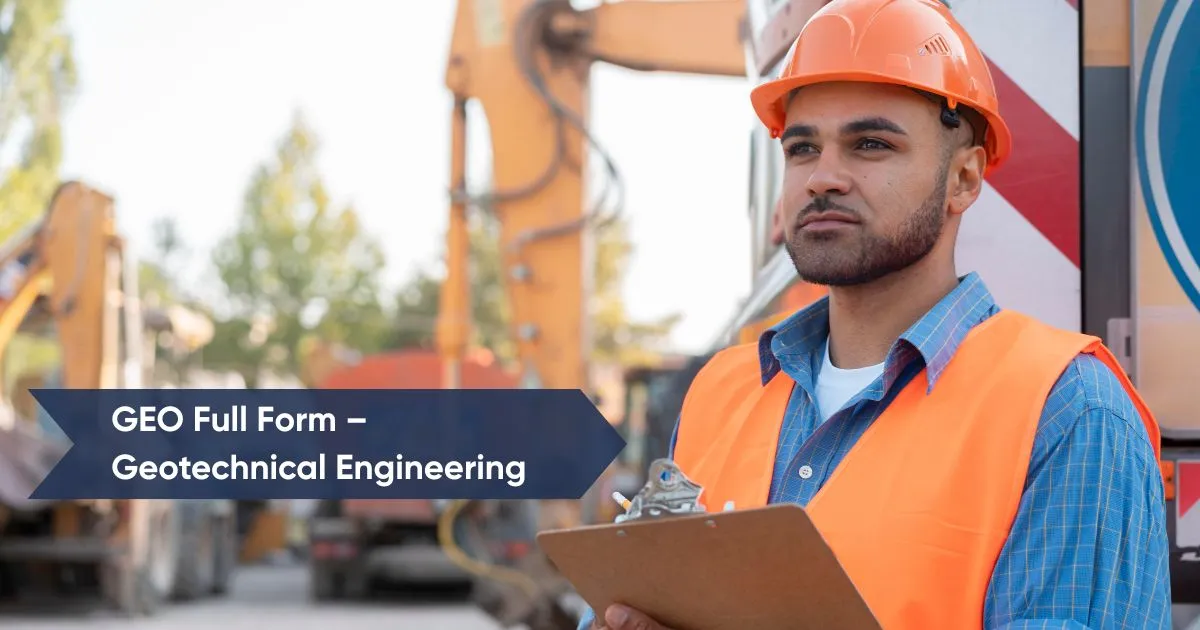
Geotechnical Engineering is a branch of civil engineering that focuses on studying the behavior of earth materials. It plays a crucial role in civil, military, mining, and petroleum and other fields of engineering that involve construction on or beneath the earth’s surface. The main areas of work include investigations, laboratory studies, foundation design, slope stability and ground improvement. It is hence a practical field that helps study and predict the success of various civil projects.
Geotechnical meaning implies the study of soil, rock, and groundwater conditions to ensure safe and stable construction. Earlier construction practices often relied on inaccurate testing methods, which sometimes led to structural failures. These challenges highlighted the need for a more reliable and scientific understanding of ground behavior, leading to the growth of geotechnical engineering as a crucial branch of civil engineering.
The development of geotechnical engineering became more structured in the 20th century, particularly with Karl Terzaghi’s work in Erdbaumechanik. His contributions provided a scientific and quantitative approach, helping base construction decisions on real ground conditions rather than assumptions.
These areas focus on the study of soil, rock, slopes, foundations and ground stability. They provide the basis for safe, practical design in civil engineering projects.
Geology helps study soil, rock, groundwater and landforms to determine the suitability of the land for construction. This helps engineers identify hazards early, which include slope instability, erosion, landslides, settlement issues and weak soil. Geology also helps guide decisions about excavation, drainage, tunnelling, and foundation depth, thereby improving construction efficiency, durability, and safety.
The scope of Geotechnical Engineering includes analysing soil and rock mechanics to design safe foundations, tunnels, and earthworks. Key areas include site investigation, foundation design, slope-stability analysis, earthworks, and environmental geotechnics. These activities of Geotechnical Engineering help reduce construction risks and lead to more economical use of materials. Groundwater control and environmental geotechnics protect both structures and surroundings. Overall, geotechnical work lowers construction risk, improves planning, and yields more economical, durable designs.
A site may appear stable on the surface, but the subsurface conditions may present a different reality. For this reason, Geotech investigations are considered an essential component of major construction projects. These may include borehole drilling, soil sampling, moisture content measurement, and groundwater level monitoring. These investigations reduce delays and avoid costly redesigns caused by unexpected ground conditions. Information from geotechnical investigations also tells engineers whether to use shallow or deep foundations for buildings, roads, bridges, and other structures.
Geotechnical engineers check the strength of soil, its capacity to support weight, the likelihood of settlement, and its behavior on gradients. They collect samples, conduct laboratory tests and also evaluate the results to develop methods to enhance ground support. Additionally, they suggest strategies such as soil reinforcement, seepage control, or the prevention or reduction of soil movement that are beneficial in the construction of durable buildings.
Geotechnical engineering plays a key role in today’s modern construction. They support the design and construction of buildings, metro systems, bridges, highways, dams, and industrial structures. This helps engineers choose suitable foundations, reduce the risk of settlement or failure, and plan safer projects. The importance of geology in civil engineering also includes excavations, tunnels, retaining walls, and slope protection, where ground conditions can change the entire design approach. With better testing methods and design tools, the field continues to grow and remains essential for building strong, safe, and reliable infrastructure.
In conclusion, GEO stands for Geotechnical Engineering. The discipline helps engineers to understand the ground and analyse soil and rock behaviour. It also helps design foundations that control settlement and load transfer. Geotechnical engineering reduces construction risk, improves design precision, and ensures long?term performance of structures. As modern projects demand taller buildings, deeper excavations, and more extensive underground works, the importance of Geology in civil engineering becomes increasingly important.
Geotechnical engineering also offers good career prospects in foundation design, site investigation, and environmental geotechnics. For program details, check out the B.Tech. in Civil Engineering (Environmental Geotechnology) at JAIN (Deemed?to?be University).
Q1. What are the four types of Geotechnical?
A1. Geotechnical Engineering primarily includes soil mechanics, rock mechanics, foundation engineering, and ground improvement.
Q2. Are Geotech Engineers in demand?
A2. Yes, geotechnical engineers are in demand because nearly every construction project needs ground analysis before work begins. Their skills are especially important in infrastructure, highways, bridges, tunnels, and high-rise buildings.
Q3. What is the 2-1 method in Geotechnical Engineering?
A3. The 2-1 method is a simplified way to estimate the stress distribution beneath foundations, based on spreading the load through the soil at a 2:1 slope. It is mainly used for quick preliminary calculations.
Q4. Who is the most famous Geotechnical Engineer?
A4. Karl Terzaghi is widely known as the father of soil mechanics and one of the most famous geotechnical engineers. His work laid the foundation for modern geotechnical engineering.
Q5. What is the main focus of Geotechnical Engineering?
A5. The main focus of Geotechnical Engineering is understanding the behaviour of soil and rock so structures can be designed safely. It deals with foundations, slopes, excavations, and the interaction between the ground and built structures.
Ask an Expert for Free