FET Blogs


FET Blogs
22 December 2025
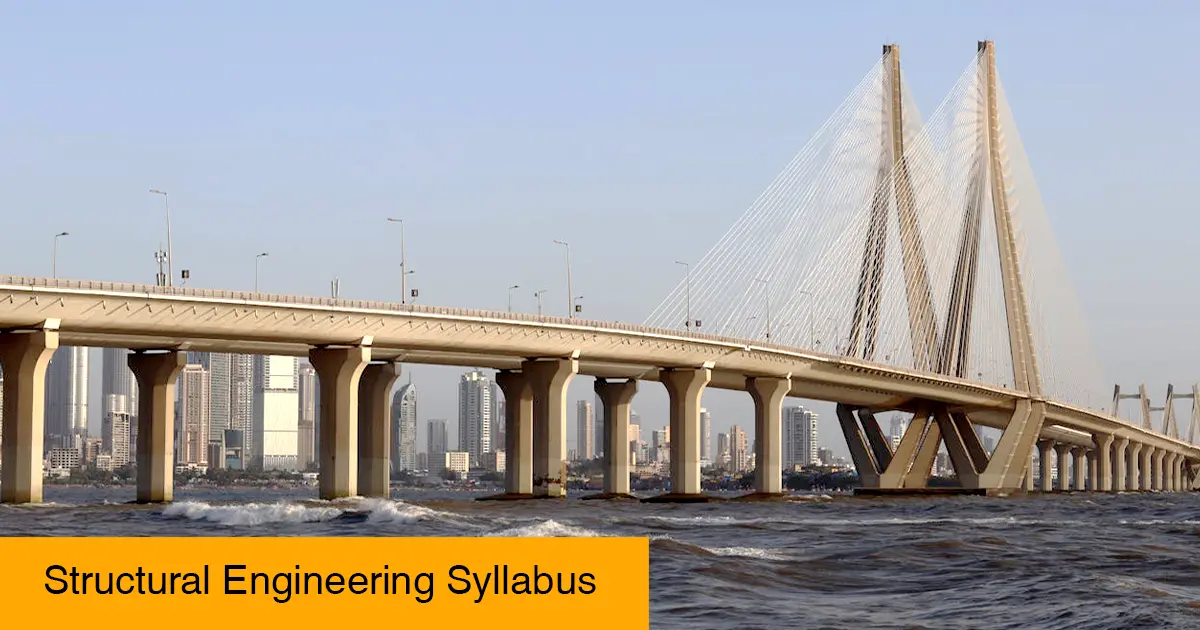
The Bandra-Worli Sea Link in India is one of the longest sea-bridges in India, with a total length of 5.6 kilometres?
It is one of the landmark engineering projects, a symbol of urban growth, ambition, and infrastructural progress.
But how do you think this engineering marvel was brought to life?
In the modern world, buildings and civil infrastructure form the backbone of every country’s progress. However, building these massive structures requires proper mobilisation of resources and energy. You also need to possess the right engineering skills to maintain the safety and durability of these structures on a large scale.
Structural Engineers help bridge these gaps by working from the early stages of a project. They work closely with architects, construction managers, and clients to evaluate feasibility, manage resources, ensure safety, and optimise cost.
As the government and the private firms plan to expand their urbanisation projects, you can consider a career in this field. This blog covers all essential details that will help you prepare for a future in this transformative profession.
Structural Engineering is an essential branch of Civil Engineering. It deals with planning, designing, constructing, and maintaining safe and durable structures.
These structures include buildings, bridges, offshore platforms, space structures, amusement park rides, and many other innovative projects.
As a Structural Engineer, you are responsible for designing the “skeleton” or structural frame of these structures so that they can withstand heavy loads and resist forces like weight, wind, earthquakes, and other environmental conditions.
If you are interested in knowing how to become a Structural Engineer in India, follow these steps. We have also listed all essential Structural Engineering course details below:
Structural Engineering is a specialisation under Civil Engineering. Therefore, the first step in becoming a Structural Engineer is to pursue a Bachelor of Technology (B Tech) or Bachelor of Engineering (B.E) in Civil Engineering.
Eligibility: Pass 10+2 from a recognised board in the Science stream (Physics, Chemistry and Mathematics) with at least 50% marks.
Entrance Exams:
The next step is to build more profound expertise in this field. To do this, you must pursue a Master of Technology (M Tech) in Structural Engineering, or a Master of Science (MSc) in Civil Engineering (Specialisation in Structural Engineering).
Eligibility: Pass B Tech/B.E. in Structural Engineering from a recognised university with at least 50% marks.
Entrance Exams:
You may take part in internships or project work in engineering consultancy firms, construction firms or research-based organisations. These experiences will help you to understand the application of this field in the real world.
You can pursue additional certifications to increase your expertise, skill level, and credibility as a structural engineer. These courses are optional and can be pursued only if you wish to develop strong domain knowledge in this field. Some of the top certifications are as follows:
As we discussed before, there is no standalone B Tech Structural Engineering syllabus exclusively offered at the undergraduate level. You have to pursue a B Tech degree in Civil Engineering, where Structural Engineering is taught as one of the core subjects. We have listed the syllabus for the B Tech in Civil Engineering.
| Semester-I | Semester-II |
| Problem Solving through Programming in C | Fundamentals of Architecture with CAD Lab |
| Fundamentals of Civil Engineering and Materials | Mind Management and Human Values - 2 |
| Mind Management and Human Values - 1 | Environmental Engineering & Sustainability |
| Calculus and Matrix Algebra | Workshop Practice |
| Applied Chemistry | Indian Language |
| Communicative English | Data Structures and Algorithms using C |
| Engineering Mechanics | Engineering Physics |
| Project Centric Learning -1 | Partial Differential Equations & Laplace Transforms |
| Project Centric Learning -1 | |
| Semester-III | Semester-IV |
| Engineering Geology & its applications in Civil Engineering | Intellectual property rights |
| Surveying I | Surveying II |
| Economics for Engineers | Fluid Mechanics and Hydraulics |
| Biology for Engineers | Open Elective II |
| Mechanics of Materials | Analysis of Determinate Structure |
| Functional Transforms and Numerical Methods | Concrete Technology |
| Open Elective - I | Internships I |
| Project Centric Learning-2 | Project Centric Learning -2 |
| Foundation of Mathematics 1 | |
| Semester-V | Semester-VI |
| Open Elective - III | Open Elective - IV |
| Scientific Foundation of Health | Transportation Engineering |
| Condition Monitoring and Maintenance Management | Design, Drawing and Detailing of RCC Structures |
| Geotechnical Engineering | Construction Technology, Safety& Management |
| AI & ML& IOT in Engineering | Professional Elective Course-I |
| Professional Elective Course-I | Quantity Surveying & Valuation |
| Software aided Construction Planning and Management. | Project Centric Learning-3 |
| Project Centric Learning - 3 | Internships II |
| Semester-VII | Semester-VIII |
| Professional Elective Course -III | Professional Elective Course -V |
| Professional Elective Course -IV | Professional Elective Course -VI |
| Design, Drawing & Detailing of Steel Structures | Creative Thinking Skills |
| Design Thinking | Capstone Project/ Internship |
| Pre-Engineered Structures | Research Publication |
| Environmental Engineering | |
| Project Centric Learning -4 |
Please note: The subjects offered in the curriculum may differ from one institute to another. We have only provided a general overview. Please get in touch with the admissions office or visit the university website for more details.
The M Tech Structural Engineering syllabus will help you gain advanced knowledge in areas like structural analysis, design methods, seismic and wind-resistant design, and finite element analysis. Let us look at the M Tech Structural Engineering subjects list:
| Semester-I | Semester-II |
| Structural Dynamics | Finite Element Method |
| Advanced Design of Concrete Structures | Earthquake Analysis And Design Of Structures |
| Advanced Concrete Technology | Construction Management Software Laboratory |
| Open Elective 1 | Structural Design Lab |
| Structural Engineering Lab | Open Elective 2 |
| Computer Aided Design Lab | PCL II - Research And Entrepreneurship Project |
| PCL I- Research and Entrepreneurship Project | Department Elective Track 2 |
| Department Elective Track 1 | Department Elective Track 3 |
| MMHV course 01 | Professional Skill Course |
| MMHV course 02 | |
| Semester-III | Semester-IV |
| Dissertation Phase 1 | Dissertation Phase 2 |
| Department Elective Track 4 | PCL IV - Research And Entrepreneurship Project |
| Open Elective -3 (Hybrid Mode) | |
| Summer Internship | |
| Structural Engineering Seminar | |
| PCL III - Research And Entrepreneurship Project |
Electives Offered in the M Tech Structural Engineering Syllabus:
Please note: The M Tech Structural Engineering subjects list mentioned above may differ from one institute to another. We have only provided a general overview. Please get in touch with the admissions office or visit the university website for more details.
A career in Structural Engineering is extensive, with lucrative opportunities across a wide range of sectors, including construction and infrastructure companies, real estate developers, government departments such as PWD, CPWD, and NHAI, metro rail and urban transport projects, etc. Some of the top career options after graduation are as follows:
| Job Role | Job Description |
| Planning Engineer | In-charge of the development of project schedules, resource estimation, and timely implementation of construction activities. |
| Structural Design Engineer | Develops safe and cost-effective structural systems based on engineering principles and analysis tools. |
| Construction Engineer | Supervises fieldwork construction, which involves ensuring that buildings are constructed as per the design and quality standards. |
| Project Manager | Plans, executes, budgets and coordinates construction projects throughout. |
| Site Engineer | Oversees the day-to-day activities at the site, monitors the progress of the construction and ensures adherence to technical specifications. |
The salary of a Structural Engineer depends on the size of the company, the job location, skills, job experience and the level of qualification. The salary of Structural Engineers has been discussed below:
| Job Level | Years of Experience | Average Salary - Lakhs Per Annum (LPA) |
| Entry-Level | 0-3 years | INR 5.8 |
| Mid-Level | 3-6 years | INR 11.65 |
| Senior-Level | More than 6 years | INR 15.65 |
With increasing urbanisation, Structural Engineering can offer lucrative job options across diverse fields. A strong academic foundation, combined with practical exposure and advanced specialisation, is key to thrive in this field.
If you aspire to build a future in this transformative field, JAIN (Deemed-to-be University) offers B Tech in Civil Engineering and M Tech in Structural Engineering. Enrol now to turn your ambition into a reality!
A1: Structural Engineering is a branch of Civil Engineering that focuses on analysing, designing, and constructing structures such as buildings, bridges, dams, towers, and other load-bearing systems.
A2: For B Tech courses, you must pass 10+2 with PCM from a recognised board with at least 50% marks. For Master's degrees, you must obtain a Bachelor's degree in the relevant field with 50% marks from a recognised university. You must qualify for the entrance exams for both courses.
A3: The key skills required for Structural Engineers include technical proficiency, designing and analysis, critical thinking, problem-solving, time management, and clear communication skills.
A4: The Structural Engineering scope is vast and extends to diverse sectors such as: Construction
A5: Salary for entry-level engineers can be INR 5.8 LPA on average. With some years of experience, skill level and added qualifications, you can earn up to INR 12 LPA.
A6: Yes. You will get a job after a Structural Engineering course, particularly with a Master's degree or additional certification courses. You can work across both the private sector (L&T, Tata Projects, consulting firms) and the government sector (PSUs, railways, highway authorities).
A7: Yes. Structural Engineering is in high-demand. The ongoing requirement to create new infrastructure, to urbanise, and to maintain older structures all over the world, and particularly in a developing economy, such as India, means that there is an increasing demand for skilled structural engineers.
Ask an Expert for Free