News


05 October 2025
Simulating Space on Earth: Student Team Earns Global Recognition at NASA Space Apps Challenge 2025
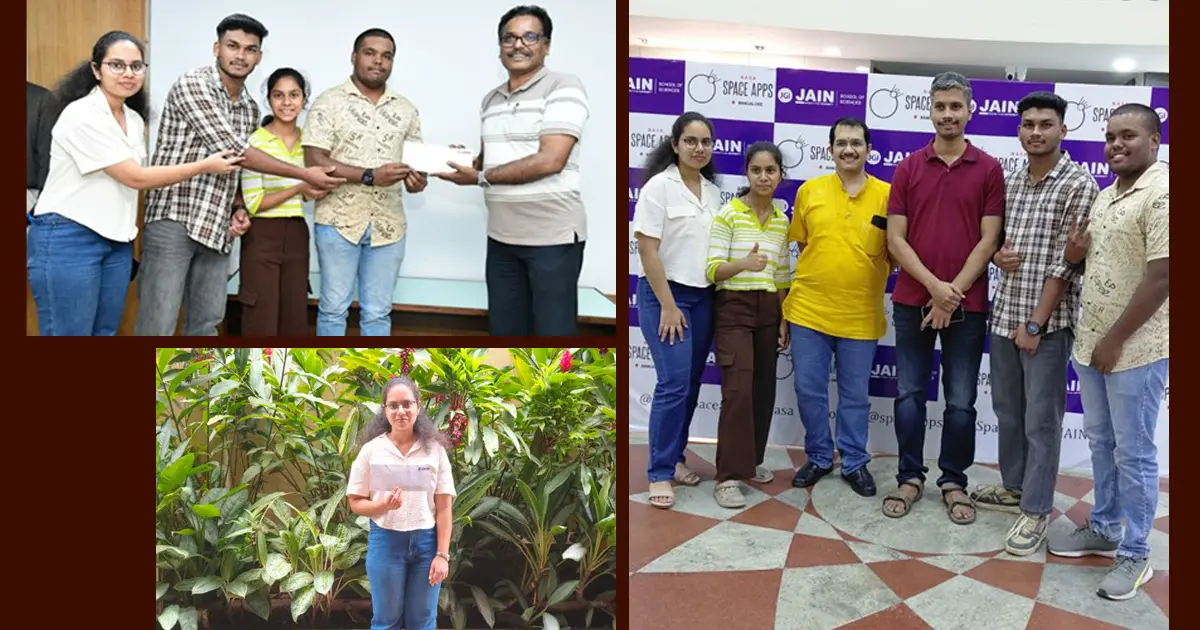
Bengaluru, 5th October 2025: Innovation, endurance, and collaboration came together at the NASA Space Apps Challenge 2025, a global hackathon that brought participants from around the world to solve real-world problems using space-based data. Hosted at the School of Science campus, JAIN (Deemed-to-be University), Bengaluru, the event saw strong participation, with over 300 attendees working in more than 80 teams during an intensive 48-hour challenge.
Designed to encourage interdisciplinary thinking, the hackathon presented 18 problem statements spanning space exploration, Earth observation, and climate science. Participants were required to ideate, develop, and present functional solutions within a limited timeframe, supported by mentors and evaluated by experts at both local and global levels.
Among the standout teams was Team Ekadanta, led by Himashwetha A U, which developed an immersive project titled ISS VR Experience - Cupola & NBL Simulation. The solution reimagined astronaut experiences aboard the International Space Station (ISS) through a virtual reality platform. By simulating the Cupola module known for its panoramic view of Earth and the Neutral Buoyancy Laboratory (NBL), where astronauts train for spacewalks, the project aimed to make space exploration more accessible and engaging.
Built using a combination of web technologies and 3D development tools, the platform integrated visual storytelling with scientific context. Users could experience orbital movement, observe Earth from space, and understand the principles of weightlessness and astronaut training. The project reflected a thoughtful blend of technical design and educational intent, highlighting the potential of immersive technologies in space science communication.
Throughout the hackathon, participants worked under continuous pressure, balancing creativity with technical execution. The collaborative environment encouraged knowledge exchange and problem-solving, with teams refining their ideas through feedback and iteration.
Team Ekadanta’s efforts were recognised with a Local Winner Award, placing them among the top five teams and earning a cash prize of ?10,000. The team further progressed through two rounds of global evaluation, underscoring the quality and relevance of their solution on an international stage.
The experience reinforced the value of hands-on, challenge-based learning in shaping future innovators. By engaging with real-world problems and global benchmarks, participants gained not only technical skills but also the confidence to contribute meaningfully to the evolving landscape of space technology and research.