News


19 January 2026
ICACEAA: A Global Leap for Aerostructures Research
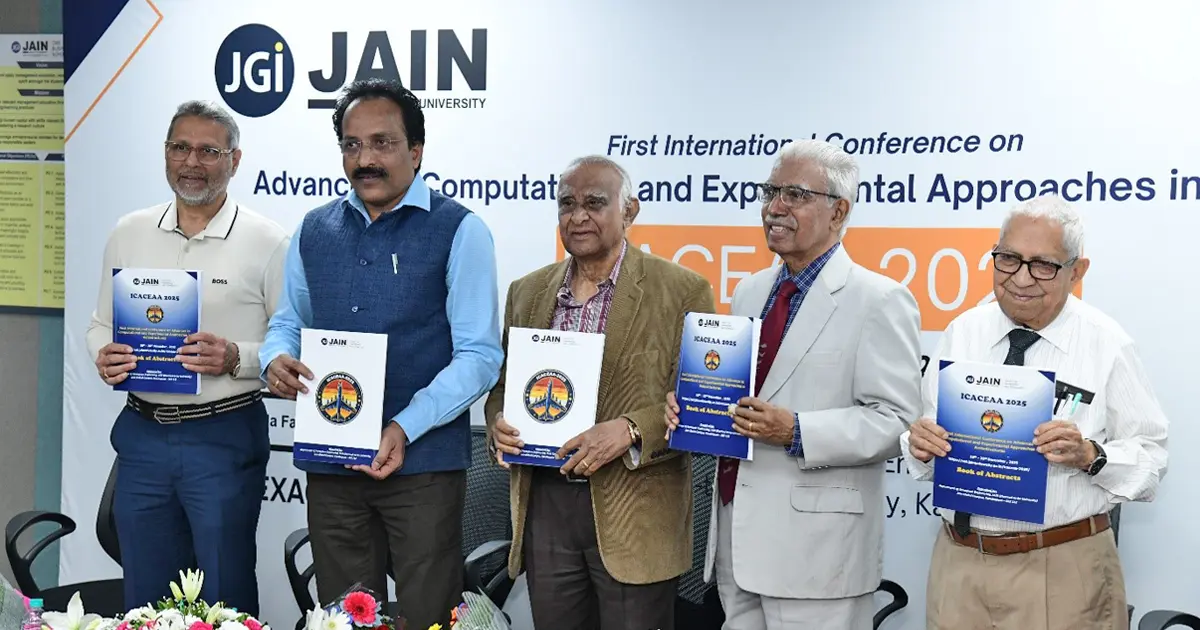
Bengaluru, 20th December 2025: The 1st International Conference on Advances in Computational and Experimental Approaches in Aerostructures (ICACEAA-2025) was successfully concluded from 17 to 20 December 2025 at JAIN (Deemed-to-be University), Bengaluru. Organised by the Department of Aerospace Engineering, the four-day event brought together researchers, academicians, industry professionals and students from India and overseas to deliberate on emerging trends in aerospace structural engineering.
The conference opened with a one-day pre-conference workshop on 17 December titled “Fatigue & Damage Tolerance Evaluation of Aerospace Structures – Current Trends and Practices”. The workshop focused on fatigue behaviour, fracture mechanics, crack growth, damage tolerance philosophy and real-world aircraft case studies. Delivered by a senior expert from the aerospace research and industry ecosystem, the session offered practical insights into certification-oriented analysis, structural integrity evaluation and life assessment methodologies. The workshop attracted aerospace engineers, MRO professionals, faculty members, researchers and students, and was noted for its application-oriented content and interactive discussions.
The main international conference, held from 18th to 20th December, served as a global platform for knowledge exchange in aerostructures and allied domains. The technical programme covered a wide spectrum of themes, including aerospace structures, fatigue and fracture, composite and smart materials, structural health monitoring, computational mechanics, advanced manufacturing, artificial intelligence and machine learning, digital twin technologies, aeroelasticity and unmanned aerial vehicle systems.
ICACEAA-2025 featured plenary and invited talks by distinguished speakers from leading institutions and organisations such as NASA, the Indian Institute of Science (IISc), Indian Institutes of Technology (IITs), DRDO, ISRO, Airbus and prominent international universities. Peer-reviewed technical paper presentations highlighted recent experimental findings, computational advancements and innovative methodologies, fostering in-depth technical discussions and collaborative research opportunities.
The conference also received strong support from industry sponsors and exhibitors, whose participation enabled industry-focused sessions, technology exhibitions and networking forums. Exhibition stalls showcased advanced aerospace technologies, products and services, promoting meaningful interaction between academia and industry and facilitating knowledge transfer.
ICACEAA-2025 achieved its objective of bridging computational innovation with experimental validation while strengthening global academic linkages and interdisciplinary dialogue. The organisers expressed gratitude to all speakers, delegates, sponsors, exhibitors and members of the organising committee for their contributions to the success of the conference, which marks a significant milestone in advancing aerospace structural research and practice.