News


10 April 2026
Percentiles to Python: Industry Talk Brings Statistics to Life for Engineering Students
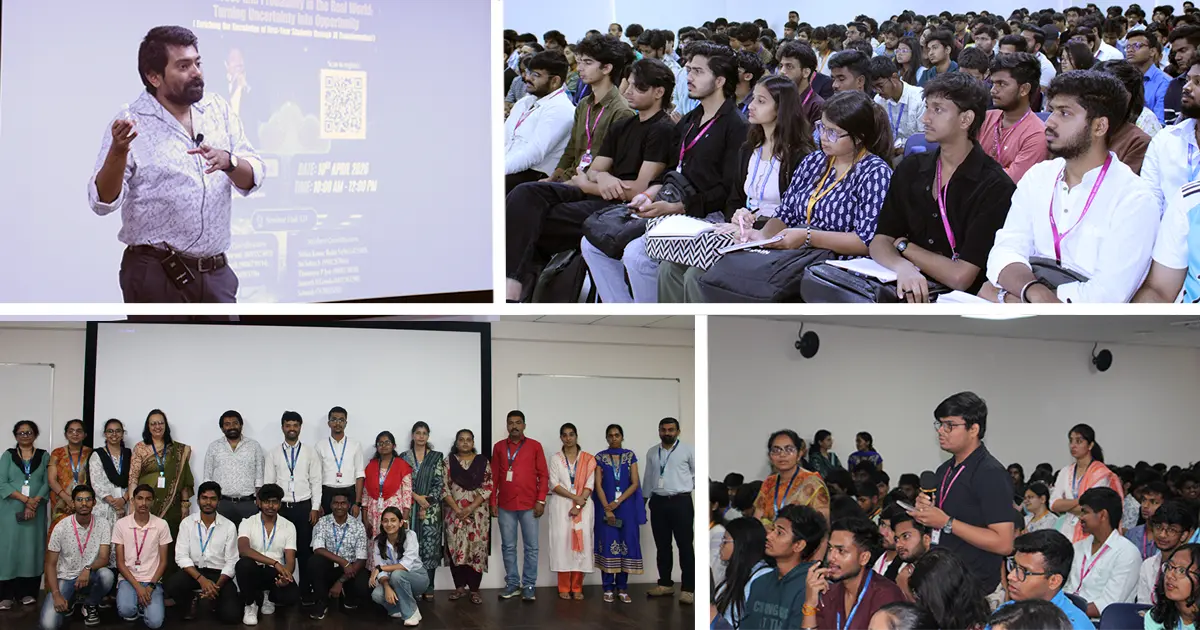
Bengaluru, 10th April 2026: The Department of Data Analytics and Mathematical Sciences at JAIN (Deemed-to-be University) hosted an industry expert session at the JAIN Global Campus, Kanakapura, drawing around 325 engineering students for a deep dive into the real-world relevance of statistics and probability. Delivered by Mr Ganeshkiran Nayak, Principal Test Engineer at Western Digital, the session explored how mathematical concepts underpin modern technology and decision-making.
Framed as a bridge between classroom theory and industry practice, the talk unfolded as a practical journey through data-driven problem-solving. Mr Nayak illustrated how statistical thinking shapes engineering outcomes, from analysing system latency using percentiles such as P50, P90 and P99, to validating product changes through A/B testing. By referencing applications at global technology firms including Google, Amazon and Netflix, he grounded abstract concepts in familiar, real-world scenarios.
A hands-on Python demonstration became a focal point of the session. Students were introduced to data analysis using Pandas and NumPy, alongside visualisation techniques involving graphs and histograms. The demonstration extended to hypothesis testing through a two-sample t-test, offering a clear view of how engineers assess improvements and make evidence-based decisions.
The discussion further expanded into case studies drawn from software engineering and data centre operations. Topics such as performance bottlenecks, system reliability, Mean Time Between Failures (MTBF), and uptime were examined in detail. A particularly engaging example, a midnight database outage showed how statistical tools like correlation analysis and hypothesis testing can diagnose and resolve critical system issues. Additional insights into storage systems, including RAID configurations and failure prediction, highlighted the role of probability in ensuring system resilience.
Student feedback reflected strong engagement, with many noting the clarity, practical relevance and interactive nature of the session. Reflection reports submitted as part of continuous assessment indicated improved analytical thinking and a stronger grasp of applied statistics.
By the end of the session, students had not only strengthened their technical understanding but also gained a clearer perspective on career pathways in data science and engineering fields where uncertainty, when understood, becomes an opportunity.