News


18 March 2026
Engineering Students Decode Low-Carbon Supply Chains in Focused Sustainability Session
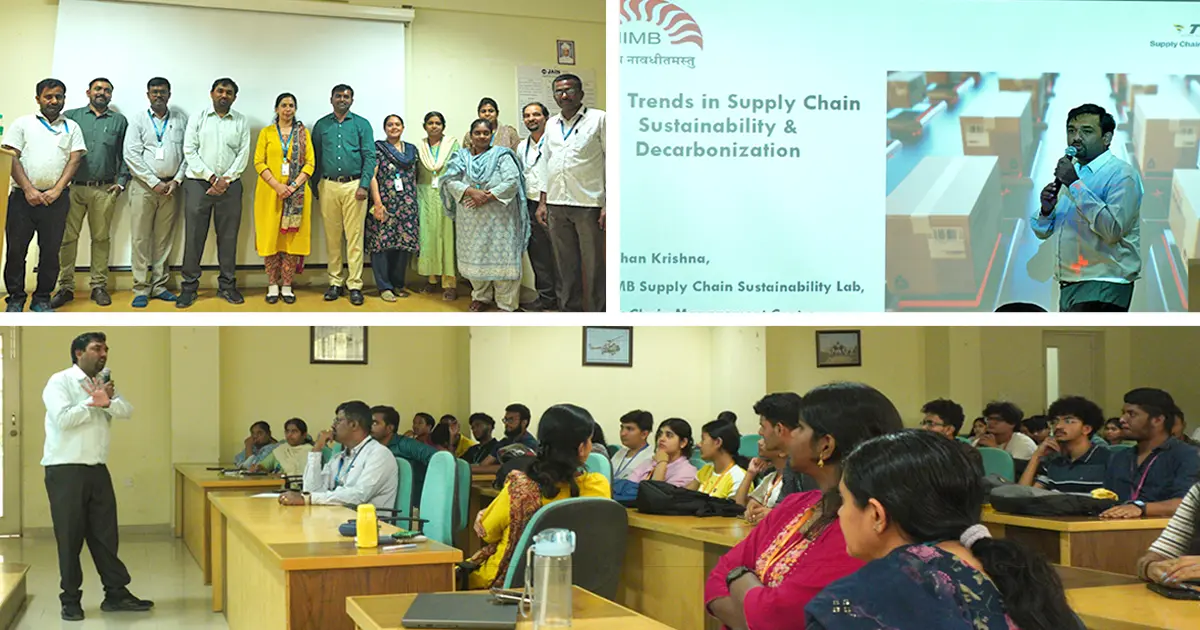
Bengaluru, 18th March 2026: The Faculty of Engineering and Technology at JAIN (Deemed-to-be University) conducted a one-day “Supply Chain Sustainability and Decarbonisation Awareness Program - 2026” on 18th March 2026 at the Aerospace Seminar Hall, JAIN Global Campus. The session, organised by the Department of Electrical and Electronics Engineering under the SPARK Club, brought together 75 students, along with faculty and staff, to explore sustainable practices shaping modern industrial systems.
The programme focused on building awareness of sustainability in supply chains, with emphasis on carbon footprint reduction, green logistics, and energy-efficient operations. Dr Vasudha Hegde and Dr Raghu N coordinated the event, while Dr Mohan Krishna, Manager (Research) at IIM Bangalore, delivered the keynote session on integrating decarbonisation strategies into industrial and global trade frameworks.
The session introduced participants to key concepts such as circular economy practices, sustainable procurement, and the use of digital technologies for monitoring emissions and optimising resources. Through case-based discussions and interactive exchanges, students examined how industries across manufacturing, transportation, retail, and energy are adapting to environmentally responsible models.
Participants engaged in structured discussions and practical examples that demonstrated how data-driven systems and smart technologies are being used to improve efficiency and reduce environmental impact. The programme also encouraged students to consider the broader societal implications of engineering decisions and to explore innovative approaches to sustainability challenges.
The initiative recorded full participation, with 75 students and 10 staff members attending. Feedback indicated that the session enhanced understanding of sustainability applications and highlighted the relevance of environmentally conscious practices in professional contexts.
The awareness programme reflects the institution’s continued integration of sustainability into engineering education, reinforcing the role of future professionals in contributing to resilient, low-carbon, and resource-efficient systems.