News


11 December 2025
M.Tech Food Technology Students of JAIN (Deemed-to-be University) Gain Industrial Exposure at Tata Consumer Products, Bidadi
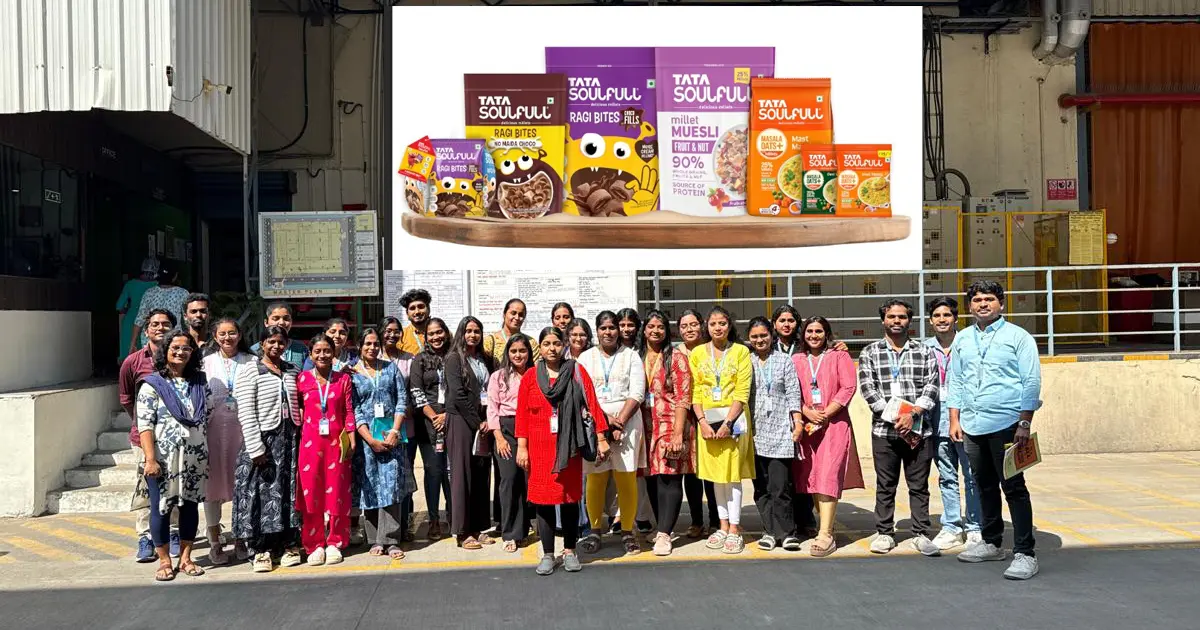
Bengaluru, 11 December 2025: The Department of Food Technology, JAIN (Deemed-to-be University), organised an industrial visit for M.Tech Food Technology students to Tata Consumer Products Limited (TCPL), including the Tata Soulfull manufacturing facilities at Bidadi and Bengaluru, on 11 December 2025. The visit aimed to provide students with first-hand exposure to large-scale cereal- and millet-based food-processing operations, industrial process control, and food-safety management systems.
The visit was led by Dr Rituja Upadhyay, Associate Professor and Head, Department of Food Technology, and coordinated by Dr Shwetha M. S. and Dr Pooja Jha, who accompanied the students throughout the programme. Industry experts Mr Sudhakar Moorthy M. and Mr Harish Salehundam guided the participants through the facility, offering detailed explanations of plant layout, unit operations, process flow diagrams, equipment functionality, and the integration of manufacturing, quality assurance, and management systems.
During the visit, students observed the practical implementation of Hazard Analysis and Critical Control Points (HACCP), Good Manufacturing Practices (GMP), and Good Hygiene Practices (GHP), while strictly adhering to prescribed safety and hygiene protocols, including the use of personal protective equipment. Particular emphasis was placed on the extrusion section at the TCPL Bidadi plant, where advanced automation, robust machine design, and precise process control are employed for millet processing. Students gained insight into the use of heavy-duty food-grade extruders, modular screw elements, temperature-controlled barrel zones, and variable-frequency drives, all of which enable efficient, hygienic, and energy-conscious production of ragi- and millet-based products.
The programme also provided in-depth exposure to the processing of Tata Soulfull products such as millet muesli and ragi-based snacks, covering raw material quality assessment, sustainable millet sourcing, extrusion cooking, roasting, drying, and post-processing operations. Students further observed automated primary and secondary packaging systems, traceability and recall mechanisms, equipment calibration and maintenance procedures. They participated in a sensory evaluation session to correlate processing parameters with final product quality.
Reflecting on the significance of the visit, Dr Rituja Upadhyay stated, “Industrial exposure of this nature is critical for bridging the gap between classroom learning and real-world food processing practices. The visit to Tata Consumer Products enabled our students to understand how theoretical principles are translated into safe, efficient, and scalable industrial operations.”
The Department of Food Technology expressed its appreciation to Mr Sandip More, Ms Smitha Upadhyaya, Ms Deepa A. C., Mr Ashish, and the entire Tata Consumer Products and Tata Soulfull team for their support and facilitation. The visit significantly enhanced students’ ability to integrate academic knowledge with industrial-scale food processing and quality management, reinforcing the University’s commitment to industry-oriented learning and professional readiness.